
Begin with the learner’s starting point
People rarely arrive with the same knowledge or confidence. One visitor may be trying a subject for the first time. Another may already practise and need feedback. Someone else may want structured preparation for a specific next step. A homepage should help these people recognise where they belong before asking them to choose a programme.
I start by writing the questions learners bring to the academy. What do I need before I begin? What will I work on? How are lessons taught? What happens if I need help? Those questions become the structure for programme pages and the content that leads people to them.
For Sagechord, I built the website, free course experience and routes into an enquiry as part of its complete digital presence. The live academy website now presents free lessons, paid programmes, a learning-path planner and track review. Each gives a learner a different way to begin.
Make the free lesson useful on its own
A free lesson should help the visitor learn something they can try. Give it a clear title, a short explanation of who it suits and any tools needed to follow along. Make the lesson easy to find again. If it belongs to a course, explain where it sits and how to continue.
Sagechord’s free courses can be started without signing up. That makes the teaching experience visible before a learner sends an enquiry. I treat this as a product decision: the learner can inspect the approach, hear the explanation and decide whether it suits them. It does not establish a sales result by itself.
Choose a next step that belongs beside the lesson. A beginner might need another free lesson or an introductory programme. Someone applying the material to an existing project might need feedback. Explain that connection in plain words so the next page feels like a continuation of their learning.
Explain the paid programme as a working experience
A programme page should help someone imagine taking part. Describe the teaching format, expected preparation, assignments, feedback and the work a learner will practise. Distinguish what the academy provides from what the learner must bring. Keep the language concrete enough for someone to discuss the commitment with a parent or colleague.
On Sagechord, programme pages display fees in two currencies for its different audiences. The useful lesson for another academy is to make the relevant commercial information understandable on its own website. Explain how a learner confirms the applicable fee and where to find programme terms before making a decision.
Keep related pages consistent. If the programme name, content or teaching arrangement changes, update the homepage, comparison page, FAQs and enquiry messages together. An outdated summary can create an expectation that the programme page then has to undo. Assign someone to maintain those details as the offer develops.
Help learners choose without making the choice for them
A catalogue can become difficult to compare when programmes serve different levels. Start with familiar questions about a learner’s experience, interests and intended work. Explain why a suggested route may suit those answers. Keep a way to ask the academy when the person’s situation needs a conversation.
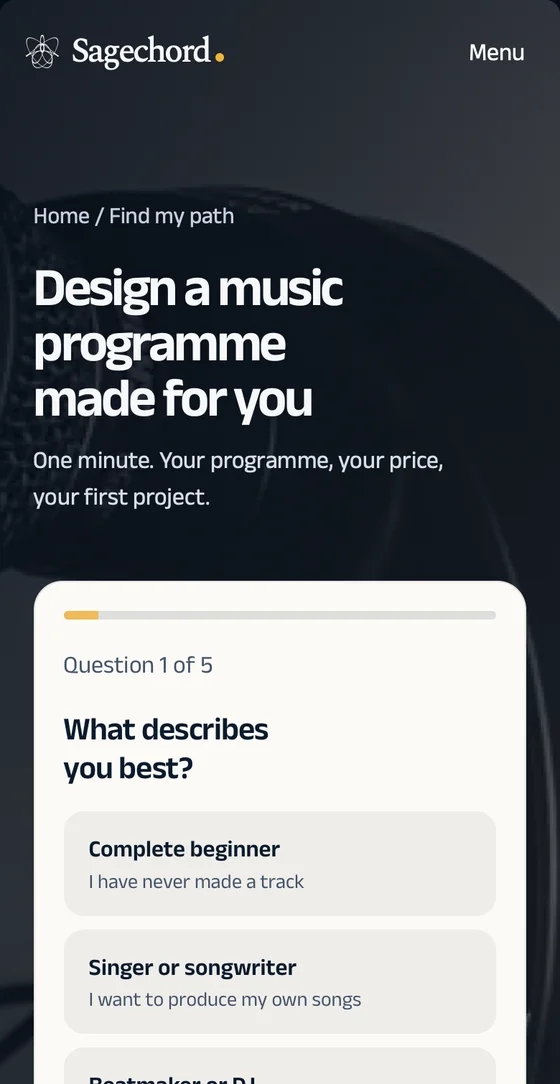
Sagechord’s Find my path planner makes that choice part of the website. It sits alongside the programme information so learners can explore the options with context. Fix My Mix provides another route for people looking for feedback on a track. These are specific pieces of the academy’s offer and should be described according to what the live pages actually provide.
You do not need to build a complicated tool immediately. A clear guide or comparison page can answer the common questions first. Build a planner when you understand the repeated decisions it should support and have a reliable way to keep its recommendations current.
Show the teaching and keep proof honest
Course previews and student story videos can help visitors understand the experience. Introduce each item accurately and make it clear what they will see when they press play. Keep video controls usable on a phone, and provide enough surrounding text for someone who is browsing without sound.
Sagechord’s site includes student story videos as well as free teaching material. Those are distinct forms of context. A lesson shows an aspect of the teaching; a student story describes that person’s experience. I would never turn either into a promise that every future learner will have the same outcome.
For an academy owner, gathering proof is an ongoing responsibility. Obtain permission for the material you publish and retain the original wording of any testimonial. Explain who teaches, what the programme covers and how support works. If you cannot substantiate a result, leave it out and show the work itself.
Keep the enquiry and the reply connected
Let learners contact the academy from the point where a question arises. A programme enquiry should carry enough context for the team to understand which programme the visitor means. Keep the form manageable, label fields clearly and explain what happens after submission. Test the confirmation on a narrow phone screen.
The operational lesson also appears in my Zarastays work. Its planning and partner portals separate different types of enquiry before they reach the business. An academy can apply the same care when distinguishing a programme question, a lesson request and a request for feedback.
Agree who replies and how an enquiry moves forward. Prepare answers to common questions, while leaving room for the learner’s situation. If the website already explains something well, link to that page in the reply. The website and the conversation should support the same understanding of the offer.
Build a content rhythm around real questions
Use questions from lessons and enquiries to shape future content. A short demonstration can introduce a technique. A longer guide can explain how to choose a learning path. A programme page can clarify what structured teaching includes. Give each piece a clear purpose and connect it to the relevant next step.
I review the whole route when deciding what to improve: where people arrive, which information they explore and what the team learns from their questions. Avoid reading a video view as a programme enquiry. Keep the stages separate and use the evidence to make a specific change.
If the journey needs rebuilding, start with Digital Presence Build. If the offer and website are already clear, an ongoing content and search scope may be a better fit. I agree the work in writing so the academy knows what is being delivered and what it needs to provide.
Questions, answered.
Does an academy need a free course?
A free course is useful when it gives learners a meaningful way to experience the teaching. A focused lesson or demonstration can also help. Choose a format you can maintain and connect it clearly to the relevant paid programme or next learning step.
What belongs on a programme page?
Explain who the programme suits, what learners will practise, the teaching format, preparation, feedback and support. Keep commercial information and terms clear on the academy’s own website. Give visitors a straightforward way to ask a question before committing.
Should every learner use a planner?
A planner can help when learners face repeated choices between different paths. Keep the underlying programme pages accessible so people can explore directly. Offer a conversation for situations that do not fit the planner’s questions.
How should an academy judge its marketing?
Review discovery, engagement with learning material, enquiries and the subsequent conversations as different stages. Combine website evidence with what the teaching or admissions team learns. Use that context to decide which explanation, page or follow-up needs attention.
